For 2,000 years, one assumption has gone largely unquestioned:
That the figure called “Jesus Christ” is the preserved biography of a single man.
This project begins with a different claim:
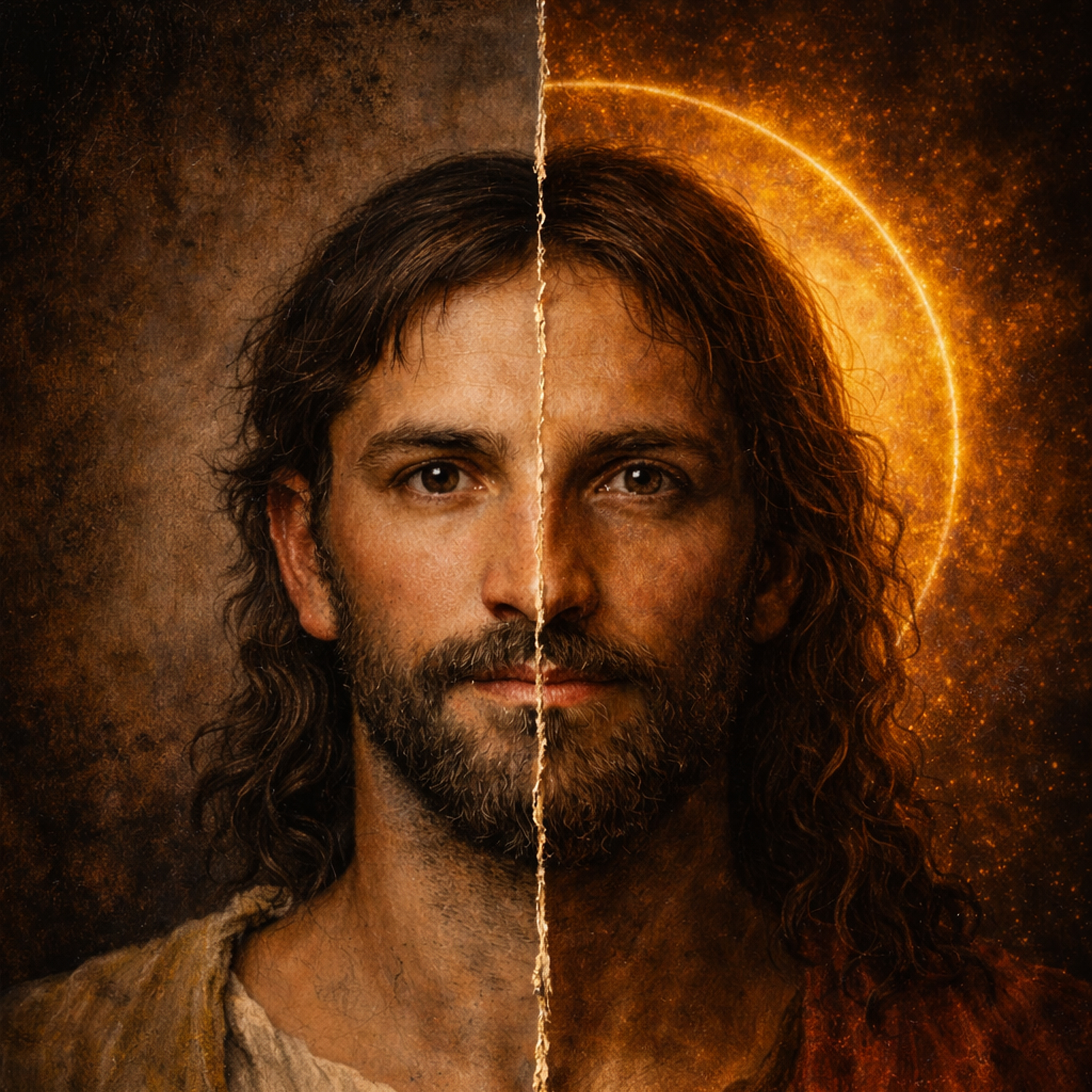
What we call “Jesus” is not a biography.
It is a fusion.
Between 6 CE and 70 CE, Judea was not quiet.
It was unstable. Violent. Fragmented.
Under Roman rule, multiple Jewish movements emerged — each carrying a different kind of authority:
- revolutionary resistance
- prophetic purification
- Torah-centered leadership
- apocalyptic expectation
These were not ideas.
They were real movements led by real figures.
And they did not survive intact.
The Problem No One Solved
For over two centuries, scholars have tried to reconstruct the “historical Jesus.”
And what did they find?
- an apocalyptic prophet,
- a wisdom teacher,
- a revolutionary,
- a mystic, or
- a divine figure.
All incompatible. All argued with confidence. None agreed upon.
That’s not a coincidence.
That’s a signal.
A Different Hypothesis
What if the problem is not the evidence…
…but the assumption?
What if we’ve been trying to extract a single life
from what was never a single life to begin with?
The Three Streams Behind the Christ (or The Three Ys Men)
This project proposes that the Gospel figure is the result of converging leadership traditions, compressed into one identity after crisis.
At minimum, three streams can be identified:
- Yehuda (Judas the Galilean)→ revolutionary theology: God alone is king
- Yohanan (John the Baptist)→ prophetic authority: purification, judgment, renewal
- Yakov (James the Just)→ Torah-centered leadership: law, continuity, structure
These were not side characters.
They were independent centers of authority.
Then Everything Collapsed
In 70 CE, Jerusalem was destroyed.
With it:
- leadership structures
- archives
- continuity
- memory stability
What remained were fragments.
And fragments don’t preserve biography.
They preserve meaning.
The Gospels Did Something Radical
They did not simply record events.
They stabilized identity.
They took:
- fragmented memories,
- overlapping traditions,
- competing authorities,
…and fused them into a single, portable figure:
The Christ
A figure capable of:
- surviving displacement,
- unifying communities, and
- carrying multiple roles at once.
What This Explains (That Nothing Else Does)
Suddenly, things that were “problems” become expected:
- contradictions between Gospels,
- radically different portraits of Jesus,
- Paul’s near silence on Jesus’ life, and
- tension between Jerusalem and diaspora traditions.
These are not errors.
They are layering artifacts.
What This Project Is (And Is Not)
This is not an attack on belief.
This is not mythicism.
This is not theology.
This is a historical model.
A simple one:
Movements under trauma do not preserve people.
They preserve roles.
And sometimes…
those roles merge.
The Claim
Yes! Yeshua-bar-Yosef existed.
But what survived him
was not ONLY his biography.
It was a convergence of identities,
reshaped under crisis,
and stabilized into the figure we now call:
Jesus Christ
Why This Matters
Because if this is true:
- the contradictions are meaningful,
- the diversity is historical,
- the confusion is evidence, and
- the origins of Christianity become intelligible.
Not as mystery.
But as process.
This Is Where We Begin
This series will reconstruct that process.
Not by speculation.
But by following:
- history,
- memory,
- power, and
- collapse.
Until the figure of Christ becomes visible again—
not as a single man,
but as the result of many.
 Yeshua Before Christ