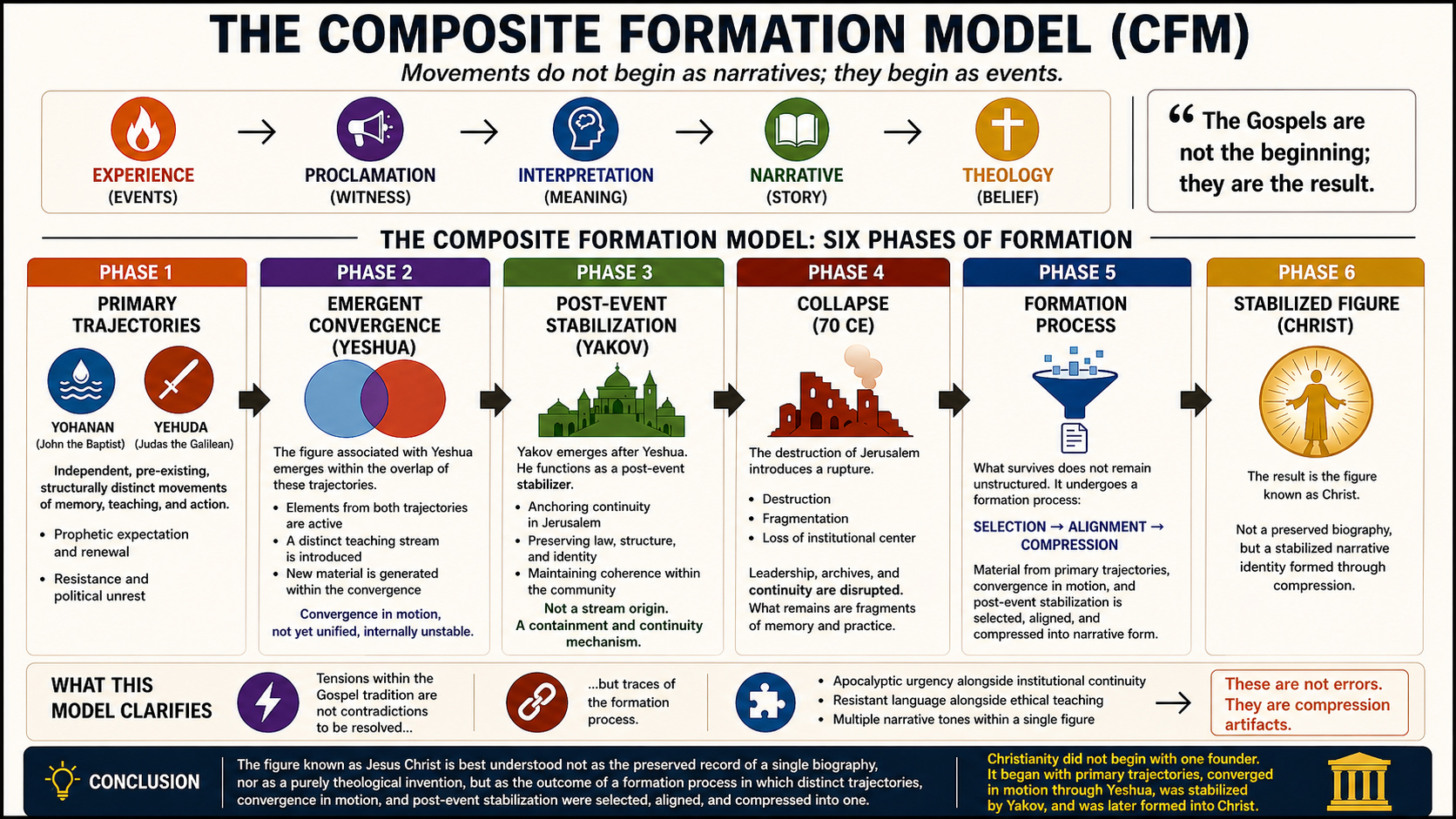
Exploring a structured model for understanding Christian beginnings.
For nearly two thousand years, the origins of Christianity have been understood as the story of a single individual, a teacher who proclaimed the kingdom of God, gathered followers, was executed, and whose life became the foundation of a global religion. The Gospel narratives present this figure with clarity and coherence, naturally leading to the conclusion that Christianity began with one founder whose identity and message were preserved in unified form.
This study challenges that assumption by asking a different question: what if that clarity is not the starting point, but the result of a longer and more structured formation process? When the material is approached from this angle, a different pattern begins to emerge. The figure at the center of the Gospels does not appear to originate as a single, unified individual; instead, that figure takes shape gradually through a series of identifiable phases within a larger process of formation.
Phase 1 — Primary Trajectories
Within the historical environment of first-century Roman Judea, an environment marked by prophetic expectation, political unrest, and competing visions of renewal, distinct movements can be identified that operate independently of one another. Among these are the prophetic movement associated with Yohanan (John the Baptist) and the resistant movement associated with Yehuda (Judas the Galilean).
These are not simply individuals, but fully formed trajectories. Each exists prior to any later synthesis, each develops along its own line, and each carries a distinct pattern of memory, teaching, and action. They are independent, pre-existing, and structurally different, representing separate responses to the same unstable world.
Phase 2 — Emergent Convergence (Yeshua)
What begins as separate does not remain separate. Over time, these trajectories begin to overlap, and within that overlap a new figure emerges, one associated with Yeshua. This figure does not stand outside the trajectories or appear alongside them as a separate origin; instead, he operates from within their intersection.
In this phase, elements from both trajectories are active at the same time, while a distinct teaching stream also begins to take shape. New material is generated within this overlap, but the result is not yet a unified identity. What exists here is better understood as convergence in motion: active, developing, and internally unstable, with multiple currents still visible beneath the surface.
Phase 3 — Post-Event Stabilization (Yakov)
The movement does not end with convergence. Once the period of convergence has passed, what remains requires continuity, structure, and preservation. This is where Yakov (James the Just) becomes central.
Yakov does not originate a new trajectory, nor does he participate in the earlier convergence itself. Instead, he functions as a post-event stabilizer, anchoring the movement in Jerusalem and preserving its law, structure, and identity. His role is to maintain coherence within the community, ensuring that what emerged during convergence does not dissolve. This phase is therefore not a new beginning and not a continuation of convergence, but a mechanism of containment and continuity.
Phase 4 — Collapse (70 CE)
This stability does not hold indefinitely. The destruction of Jerusalem in 70 CE introduces a decisive rupture that disrupts the entire structure. Institutions collapse, leadership is fractured, and the physical and organizational center of the movement is lost.
What remains after this event is not a stable system, but fragments, pieces of memory, teaching, and practice that survive without the framework that once held them together. The continuity established in the previous phase is broken, and the movement enters a new condition defined by fragmentation.
Phase 5 — Formation Process
These fragments do not remain scattered indefinitely. Over time, they undergo a process of reorganization that can be described in three movements: selection, alignment, and compression.
Material drawn from the earlier trajectories, the period of convergence, and the phase of stabilization is selected from what survives, brought into alignment with other material, and then compressed into narrative form. What emerges from this process is not a simple record of events, but a constructed narrative identity shaped by the need to create coherence out of fragmentation.
Phase 6 — Stabilized Figure (Christ)
The final result of this process is the figure known as Jesus Christ. This figure is best understood not as a preserved biography in the modern sense, but as a stabilized narrative identity formed through the compression of multiple streams into a single, coherent form.
The clarity seen in the Gospel narratives, then, is not evidence of a single point of origin, but the outcome of a process that has already resolved complexity into unity.
What This Model Clarifies
When viewed through this model, tensions within the Gospel tradition begin to make sense in a new way. Elements that might otherwise appear contradictory, such as apocalyptic urgency existing alongside institutional continuity, or resistant language appearing alongside ethical teaching, no longer require resolution.
Instead, they can be understood as traces of the formation process itself, where different trajectories and phases have been brought together within a single narrative. The presence of multiple tones within one figure is not an error or inconsistency, but a visible result of compression.
Conclusion
The figure known as Jesus Christ is therefore best understood not as the preserved record of a single biography, nor as a purely theological invention, but as the outcome of a structured formation process. Within this process, distinct trajectories, convergence in motion, and post-event stabilization were selected, aligned, and compressed into one coherent narrative identity.
This model does not reject the Gospel tradition; it explains how that tradition came to take the form we now recognize.
Christianity, in this view, did not begin with one founder, but with multiple trajectories that converged in motion through Yeshua, were stabilized by Yakov, and were later formed into a single, unified figure.
When this process is applied to the Gospel material, a different picture begins to emerge.
→ links to Thesis