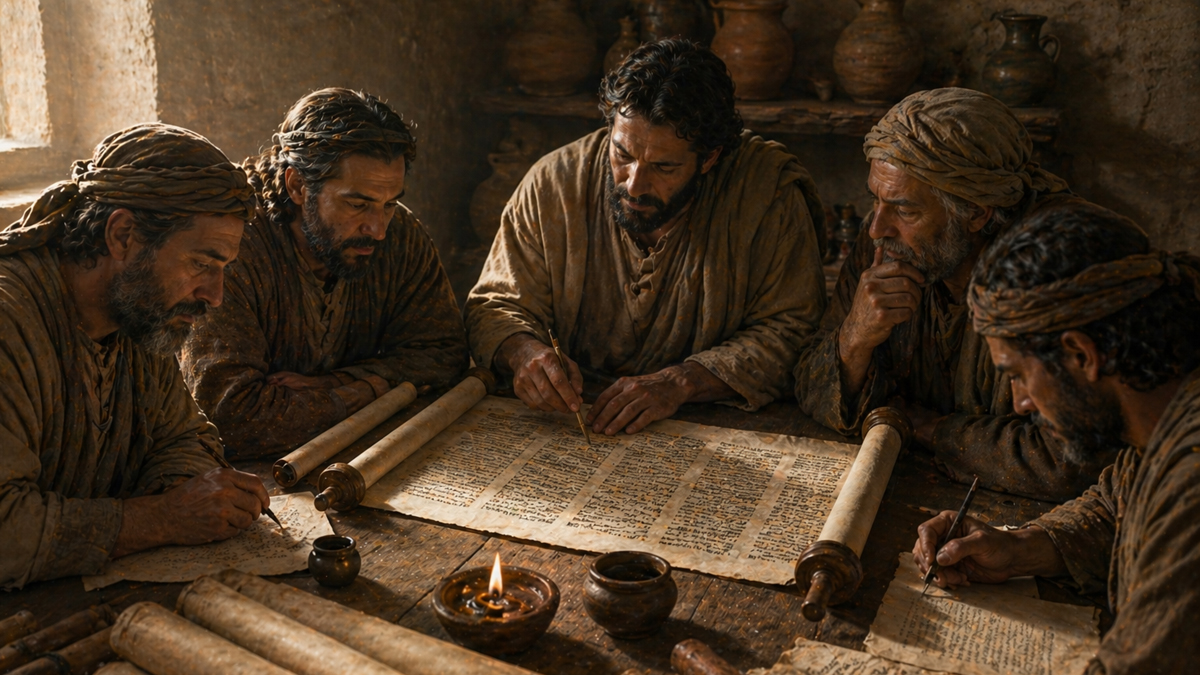
Who shaped the figure we now call Christ?
If the figure at the center of the Gospels is the result of convergence, then that convergence did not organize itself. It was shaped, selected, arranged, and stabilized by those who worked to bring multiple traditions into a single, enduring form.
The Gospels are often treated as eyewitness accounts, as though they were written to document events exactly as they occurred. But when we read them carefully, they present themselves differently. They are structured, selective, and composed. They do not simply report what happened; they organize material in a way that creates coherence from what was originally fragmented.
After 70 CE, the situation facing these communities demanded more than preservation. It required reconstruction. With Jerusalem destroyed and traditional centers of authority gone, communities were left dispersed, fractured, and without a unifying structure. There was no longer a single place, leader, or institution capable of holding identity together. In that absence, something else had to take on that role.
This is where the Gospel writers come into focus, not as passive transmitters of tradition, but as editors of it. They did not invent their material from nothing, but they worked with what remained: sayings, stories, memories, expectations, and traces of competing authorities drawn from different movements and different communities, all rooted in a world that no longer existed in its original form.
The challenge they faced was not a simple one. They had to shape a figure capable of unifying divided traditions, carrying multiple forms of authority at once, surviving across different regions, and functioning without dependence on a central institution. This is not merely storytelling. It is a deliberate process of constructing identity under constraint.
They accomplished this through a series of careful and intentional choices. They selected which traditions to emphasize and which to reduce, recognizing that not everything could be carried forward equally. They arranged material in a way that created narrative coherence, placing events and teachings in sequences that guided how they would be understood. They framed potentially conflicting elements so they could coexist without breaking the narrative, often softening or redirecting tensions that could not be resolved directly. And they attributed diverse sayings and actions to a single voice, allowing multiple streams of authority to be heard through one figure.
The result of this process is not randomness, but intentional structure. What emerges is a single, central figure capable of holding multiple roles without collapsing under their weight. This figure becomes the new center, portable, durable, and able to unify communities that no longer share a common place or institutional framework.
This was necessary because, without such a center, fragmentation would continue. Authority would disperse, identity would weaken, and the traditions themselves would risk disappearing. The fused figure solves this problem by providing continuity in a form that can move across geography and endure over time.
But this process also leaves visible traces. The tensions do not disappear entirely, contradictions remain, and seams can still be seen within the text. These are not signs of failure on the part of the writers, but evidence of what they chose to preserve. In holding multiple streams together, they allowed those differences to remain, even as they brought them into a single narrative.
Once you know how to look, these seams become visible. You can see where one layer interrupts another, where the tone shifts unexpectedly, and where different roles overlap without being fully reconciled. These are not mistakes or inconsistencies; they are editorial joins—points where distinct traditions have been connected.
This leads to a different way of understanding the Gospels. They are not pure biographies, nor are they inventions detached from history. They are best understood as curated convergence—a deliberate effort to stabilize identity after historical collapse by bringing multiple streams into one coherent form.
Within that form, the figure we call “Jesus Christ” emerges as prophet, king, and lawgiver, not because a single individual perfectly embodied all of these roles in isolation, but because multiple traditions were drawn together and expressed through one narrative identity.
At this point, the central claim is complete. The Gospels did not simply preserve a life; they shaped a figure. That figure is built from memory, shaped by necessity, guided by selection, and refined through the demands of survival.
This changes the question we ask of the text. Instead of asking whether events happened exactly as described, we begin to ask why they were shaped in this particular way, what pressures influenced their form, and what purposes that form was meant to serve.
What emerges from this perspective is a model that can account for diversity without confusion, contradiction without error, and unity without forcing simplicity onto a complex set of traditions.
We are no longer looking at a broken or inconsistent biography. We are looking at a constructed center, formed from converging streams under historical pressure and sustained through careful editorial work.
From here, the foundation is complete. What follows is a deeper level of analysis, examining specific passages, tensions, and layers within the text, not as problems to be resolved, but as structures to be understood.
The figure at the center of Christianity did not emerge in isolation. He emerged out of collapse, memory, conflict, and survival, shaped by those who worked to preserve what remained. The editors did not invent the tradition, but without their work, it would not have endured—and once that process becomes visible, the text can no longer be read in the same way.
This is where the reconstruction begins in full.
Interested in the sources behind this study?
Our research draws upon a broad range of primary sources, historical scholarship, and modern academic studies. Rather than repeating bibliographies for each individual article, we have gathered the sources used across our research in one consolidated bibliography. Explore the Complete Research Bibliography →