Prefatory Note
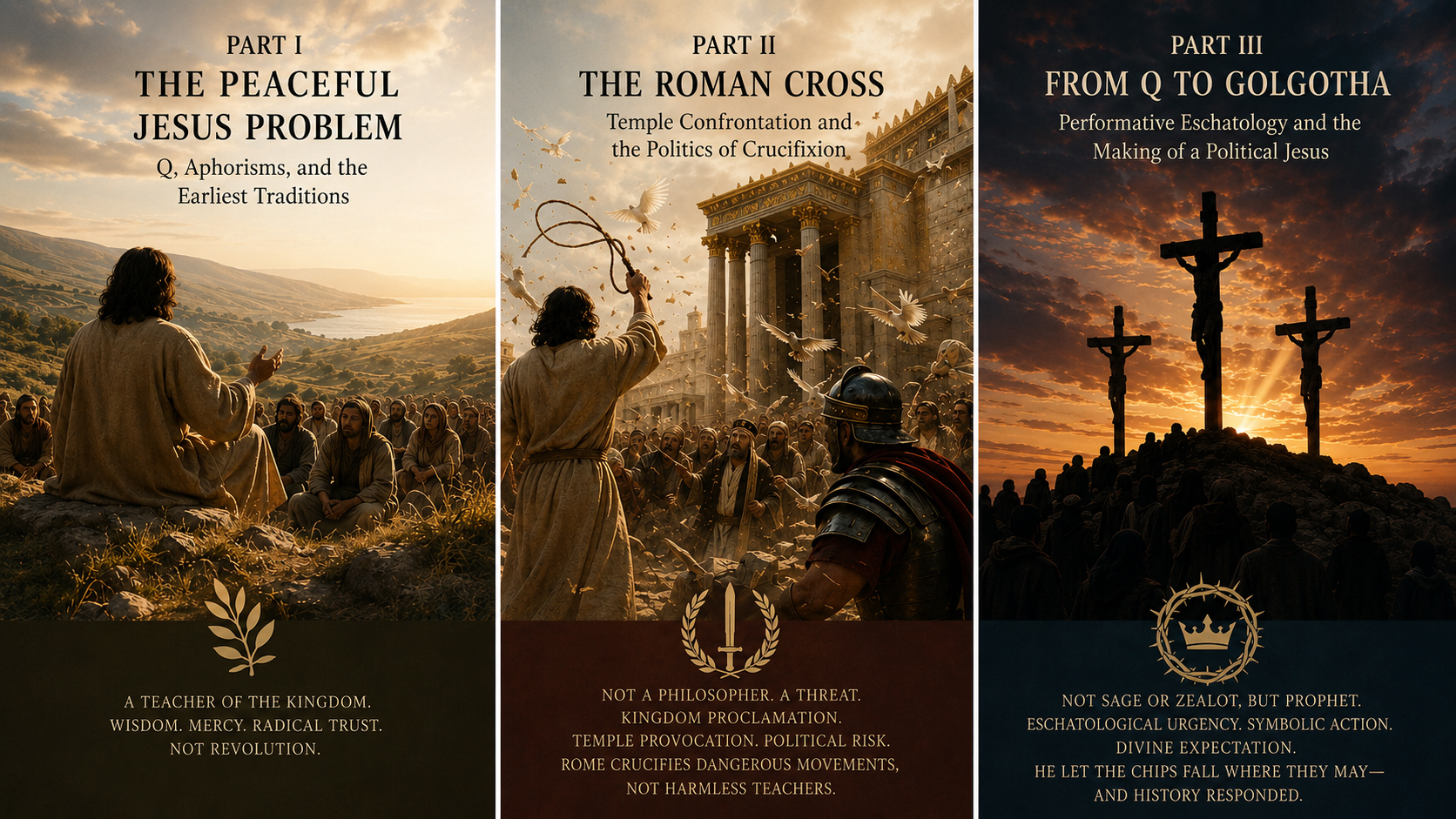
Few questions in modern historical Jesus research are as difficult, or as destabilizing, as the one at the center of this study. If the earliest recoverable traditions associated with Jesus preserve an aphoristic teacher concerned with radical ethics, social reversal, trust in God, and itinerant wisdom, then how did that same figure end his life crucified by Rome under charges normally associated with political instability and sedition? Put simply, how does a teacher of enemy love become a man executed on a Roman cross?
For decades, scholars have largely divided into competing camps. One group, associated especially with the reconstruction of the Sayings Gospel Q and scholars such as Burton Mack, has emphasized the nonviolent, wisdom-oriented dimensions of the earliest traditions. Another group, represented in different ways by writers such as Hyam Maccoby, has emphasized the political volatility of Roman Judea, the Temple confrontation, the symbolism of kingship, and the fundamentally political nature of crucifixion itself.
The problem is that both camps appear to preserve something important.
The earliest sayings traditions do not naturally resemble revolutionary propaganda. Yet Rome did not normally crucify harmless philosophers wandering through Galilee discussing spiritual ethics. The contradiction is real, and any historically serious reconstruction must confront it directly rather than dissolve one side of the evidence in favor of the other.
This study proposes that the contradiction itself may preserve the outline of a more historically realistic process. Instead of forcing Jesus into the modern categories of either peaceful sage or armed revolutionary, we may need to reconsider the unstable world of apocalyptic Judaism itself, where prophetic symbolism, divine expectation, Temple critique, and political volatility were deeply intertwined. Within that environment, symbolic acts could become politically explosive without necessarily constituting organized military revolt.
The argument developed in the following three-part study suggests that the earliest Jesus movement may indeed have begun as a largely aphoristic and socially radical renewal movement, but that escalating apocalyptic expectation, intensified perhaps by the execution of Yohanan the Baptizer (John the Baptist), eventually transformed symbolic prophetic action into something authorities perceived as politically dangerous.
In this reconstruction, Jesus need not become either a pacifist philosopher accidentally swept into tragedy or a conventional insurgent secretly organizing armed revolt. Instead, he emerges as an apocalyptic-prophetic figure participating in what may best be described as performative eschatology: symbolic actions undertaken in the expectation that God was about to intervene decisively in history.
This framework does not solve every historical problem, nor does it claim certainty where the evidence remains fragmentary. What it attempts to do is provide a more coherent explanation for why the surviving traditions appear so unstable, layered, and internally contradictory.
Those contradictions may not be evidence of failure. They may instead be traces of multiple historical streams later gathered together, stabilized, and transformed into the Christian narrative that survived.
→ Continue through From Q to Golgotha: Part I — The Peaceful Jesus Problem: Q, Aphorisms, and the Earliest Traditions