Whatever else may be uncertain about the historical Jesus, one fact remains extraordinarily difficult to explain away: Rome crucified him.
This matters because crucifixion was not simply an execution method. It was a political instrument designed to display imperial dominance publicly and violently. Roman authorities reserved crucifixion primarily for slaves, rebels, insurgents, bandits, and individuals considered threats to public order. The punishment was intentionally humiliating, theatrical, and terrifying. It warned populations what happened to those who challenged Roman stability.
This immediately creates tension with the earliest aphoristic traditions associated with Jesus. A wandering teacher discussing enemy love and radical trust in God does not naturally resemble the kind of figure Rome typically executed through crucifixion.
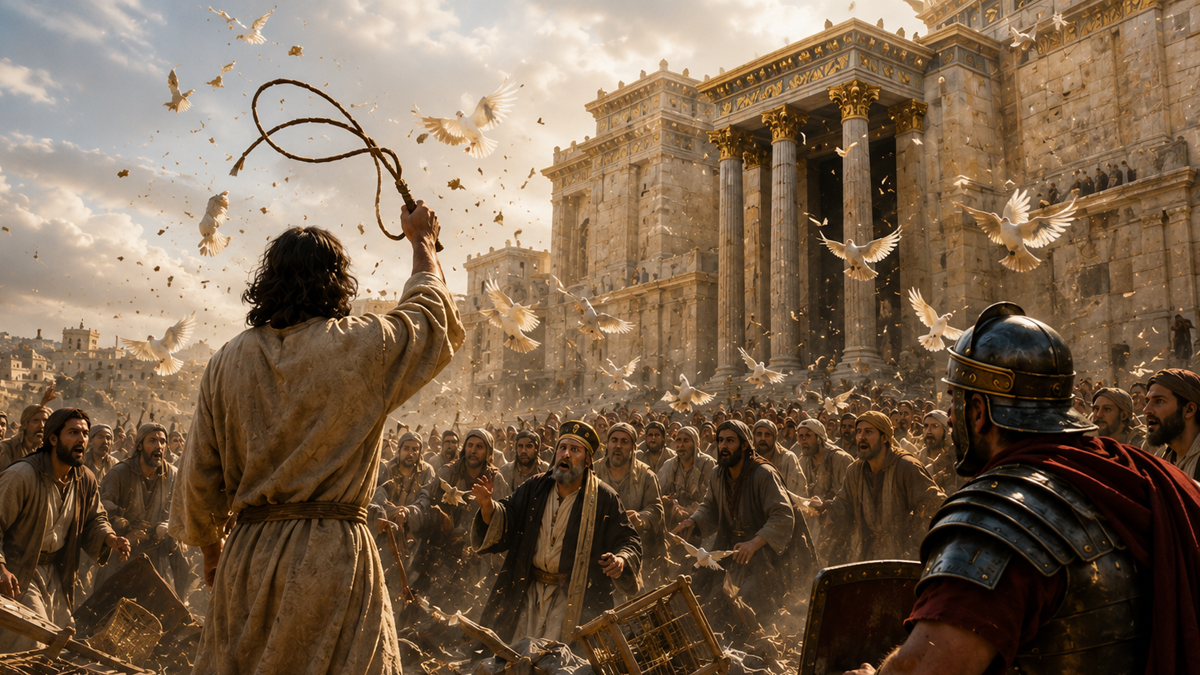
For this reason, many scholars and historians have increasingly emphasized the political dimensions of Jesus’ final days in Jerusalem. The Temple confrontation, the kingdom proclamation, the public procession into the city, and the title “King of the Jews” all point toward a much more volatile situation than later spiritualized interpretations often acknowledge.
The key issue, however, is understanding what “political” meant within the world of Second Temple Judaism.
The symbolic atmosphere surrounding Jesus’ entry into Jerusalem becomes even more significant once viewed against the prophetic framework of Zechariah. The procession traditions preserved in the gospels strongly echo Zechariah 9:9, in which a humble king enters Jerusalem riding upon a donkey while announcing divine kingship and peace. Within Second Temple Judaism, such imagery would not likely have been interpreted as accidental. Scriptural reenactment, prophetic symbolism, and eschatological expectation were deeply intertwined.
The broader apocalyptic framework of Zechariah may also be important, particularly in relation to the Mount of Olives traditions and the symbolic logic surrounding Jesus’ final actions in Jerusalem. Zechariah 14 associates the final divine confrontation with Jerusalem, the Mount of Olives, and the Feast of Tabernacles (Sukkot), portraying a climactic moment in which God intervenes directly within history against the nations gathered around the city. These traditions appear to have remained symbolically powerful within Jewish apocalyptic imagination well into the first century.
Seen within this context, Jesus’ symbolic entry into Jerusalem on a foal during a festival season charged with royal and eschatological expectation may have carried far greater political significance than modern readers often recognize. Whether or not organized revolt was intended, such actions could easily be interpreted as participation within an unfolding prophetic drama grounded in sacred history itself.
Modern readers often imagine political rebellion primarily in military terms. We think of armies, organized revolt, weapons, and strategic warfare. But first-century Judea was filled with movements that occupied a much more fluid space between religion, prophecy, symbolism, and politics. Prophetic acts themselves could become politically explosive because they challenged existing authority structures while invoking divine legitimacy.
The historian Josephus preserves several examples of this phenomenon. Among the most important is an incident from 45–46 CE involving a figure known as Theudas. According to Josephus, Theudas gathered followers near the Jordan River while promising that the waters would divide. On the surface, this may appear bizarre or irrational to modern readers, but within the symbolic world of apocalyptic Judaism, the meaning becomes clearer. Theudas was not simply organizing military revolt. He appears instead to have been reenacting sacred history itself.
The Jordan carried enormous symbolic significance because it echoed the Exodus traditions and Israel’s entry into the Promised Land. By gathering followers near the river and expecting divine intervention, Theudas may have believed that God was about to repeat the foundational acts of Israel’s sacred past. This was not ordinary politics. It was prophetic-apocalyptic theater grounded in the expectation that history itself was approaching transformation. Yet Rome crushed the movement anyway, dispersing his followers and reportedly carrying his severed head to Jerusalem as a public warning against prophetic unrest.
This example is critically important because it reveals how Roman authorities responded to prophetic symbolism within volatile environments. A movement did not need to possess a conventional army in order to become dangerous. If large crowds gathered around apocalyptic expectations, divine kingship, or covenantal renewal, authorities could easily interpret the situation as a threat to public stability. This broader context helps illuminate the final phase of Jesus’ movement.
By the time Jesus entered Jerusalem, the atmosphere surrounding him may already have been escalating. The proclamation of God’s kingdom, the growing crowds, the symbolic procession into the city, and the confrontation with Temple practices all carried political implications whether or not organized violence was intended.
The Temple itself was not merely a religious institution. It functioned simultaneously as a spiritual center, economic hub, political symbol, and administrative power structure closely intertwined with Roman authority and priestly aristocracy. Any symbolic challenge to the Temple therefore carried far greater implications than modern readers often recognize.
This becomes especially significant if the Jerusalem events occurred during the festival of Sukkot rather than Passover, as some reconstructions suggest. Sukkot, or the Festival of Booths, possessed enormous eschatological and royal symbolism within Jewish tradition. Palm and date branches, processional imagery, covenantal themes, and expectations surrounding divine kingship all converged within the festival atmosphere. A prophetic figure entering Jerusalem on a foal amid such symbolic gestures during this period could easily generate explosive political and apocalyptic interpretations.
Within such a symbolic environment, the Jerusalem procession traditions preserved in the gospels may have carried immense apocalyptic and political force. A prophetic figure entering the city on a foal during Sukkot could easily evoke the royal and eschatological imagery associated with Zechariah’s vision of divine kingship, restoration, and final confrontation. Whether or not organized revolt was intended, the public reenactment of such scriptural symbolism within an already volatile festival atmosphere could readily be interpreted as politically dangerous.
Within this environment, the Temple action attributed to Jesus may best be understood not as random anger but as symbolic prophetic confrontation. It resembled the actions of earlier Hebrew prophets who enacted dramatic public signs announcing judgment against corruption and impending divine intervention.
This is where the concept of performative eschatology becomes historically useful. Performative eschatology refers to symbolic actions undertaken within the expectation that God was about to intervene decisively in history. The action itself becomes a prophetic enactment designed to reveal, trigger, or participate in the approaching transformation of the world. Such patterns were deeply embedded within Jewish historical memory and scriptural tradition.
From the Exodus narratives and wilderness traditions to prophetic symbolic acts performed by figures such as Elijah, Ezekiel, and Jeremiah, Israel’s sacred history repeatedly preserved the expectation that God acted through dramatic interventions within history itself. These traditions were not distant literary memories but living cultural frameworks that continued to shape apocalyptic expectation in the first century. Within such an environment, later prophetic figures could easily come to believe that sacred history was once again approaching fulfillment through symbolic reenactment and divine intervention. This framework helps explain several otherwise difficult tensions within the Jesus traditions.
It explains how Jesus could preserve largely aphoristic teachings while still becoming politically dangerous. It explains why symbolic acts mattered so intensely within Jerusalem. It explains why the movement appears simultaneously nonmilitary and yet highly unstable. Most importantly, it explains why Rome may have responded with crucifixion even if Jesus was not leading a conventional armed revolt.
The death of Yohanan the Baptizer may also become newly significant within this framework. Yohanan’s execution demonstrated that prophetic movements invoking covenantal renewal and imminent judgment could already provoke political suppression. If Jesus understood Yohanan’s death as confirmation that corruption had reached its climax, then the pressure toward decisive symbolic action may have intensified dramatically. This does not require the conclusion that Jesus became an organized revolutionary commander. In fact, the surviving evidence for systematic military preparation remains remarkably thin.
The traditions surrounding the swords in Gethsemane illustrate this instability perfectly. On the one hand, the presence of swords suggests at least some awareness of danger and confrontation. On the other hand, the narratives collapse almost immediately into confusion rather than organized resistance. One disciple strikes. Jesus rebukes the action. The movement disintegrates. No sustained armed defense follows.
This does not resemble a carefully planned military uprising. It looks more like a movement caught between prophetic expectation and political reality. That distinction matters enormously.
Apocalyptic movements often occupied precisely this unstable middle ground. They were neither fully peaceful in the modern sense nor conventionally militant. They operated through symbolic gestures, scriptural reenactment, divine expectation, and public prophetic confrontation. Participants may have believed that God himself would intervene decisively once the proper moment of revelation arrived.
Within that framework, even limited weapons could carry symbolic rather than strategic significance. The expectation may not have been military victory through force, but divine vindication through apocalyptic transformation. If this reconstruction is even partially correct, then the Roman response becomes much easier to understand.
A prophetic figure entering Jerusalem during a major festival, attracting crowds, proclaiming God’s kingdom, symbolically challenging Temple legitimacy, and participating in escalating apocalyptic expectation could easily appear intolerably dangerous to both Roman and priestly authorities. Whether or not organized revolt was intended may ultimately have become irrelevant. Once the movement began to generate instability within the volatile environment of Roman Judea, suppression became increasingly likely regardless of actual military intent.
→ Continue through From Q to Golgotha: Part III — From Q to Golgotha Performative Eschatology and the Making of a Political Jesus