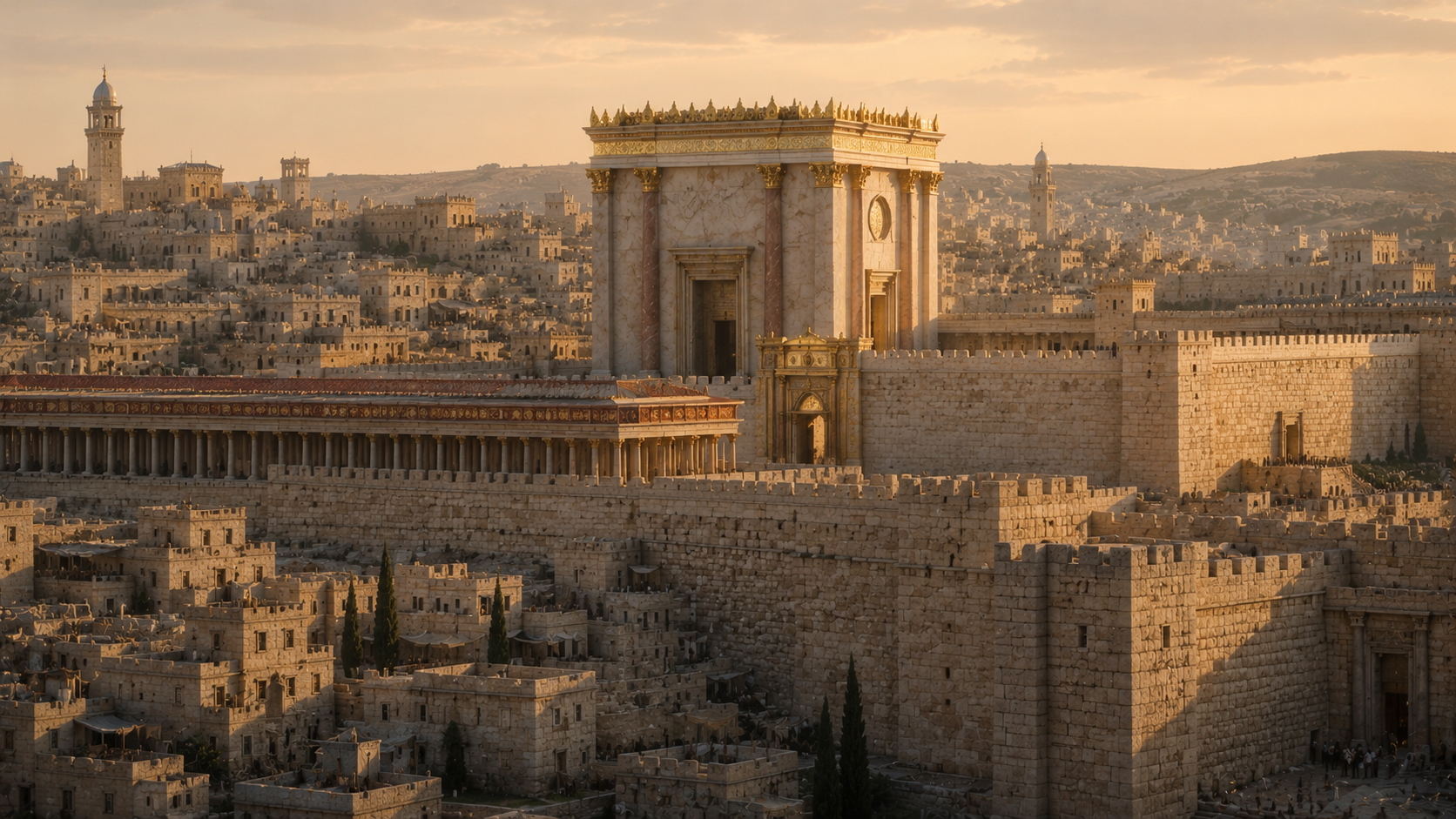
The earliest layers of the Jesus tradition appear to preserve a movement rooted primarily within the villages and rural communities of Galilee. Their dominant concerns are ethical transformation, alternative social relations, communal reconstruction, and the cultivation of covenantal identity within an unstable world. The kingdom of God often appears less as an imminent political upheaval than as a transformed mode of life embodied through new patterns of behavior and communal practice. Yet the final phase of Yeshua’s public activity presents a markedly different picture. The movement increasingly shifts away from village-centered reconstruction and toward symbolic action, sacred geography, public demonstration, and eventual confrontation in Jerusalem.
If the baptism represented the moment at which ethical adaptation began to converge with prophetic vocation, the Jerusalem mission represents the fullest historical expression of that convergence.
This transition has often proven difficult to explain. Reconstructions emphasizing Yeshua as a wisdom teacher struggle to account for the dramatic escalation represented by the Jerusalem mission. Reconstructions emphasizing revolutionary nationalism frequently find themselves projecting later political categories backward into an earlier environment that appears dominated more heavily by prophetic activism than organized insurgency. The framework developed throughout this study suggests another possibility. Rather than representing a sudden abandonment of an earlier mission, the Jerusalem journey may reflect the convergence of two currents already present within the wider historical environment: the Galilean tradition of ethical adaptation and the apocalyptic-prophetic tradition exemplified by Yohanan and the wider prophetic movements of the period.
The influence of Yohanan may be especially important in this regard. As argued earlier, Yohanan’s movement embodied a form of prophetic activism rooted in repentance, symbolic action, sacred geography, and expectation of imminent divine intervention. The traditions linking Yeshua to Yohanan almost certainly preserve memory of a significant historical relationship, even if its precise contours can no longer be reconstructed with certainty. What matters is that Yeshua appears to have emerged from an environment in which prophetic mobilization had already become a visible and compelling response to the crisis conditions of first-century Judea and Galilee.
If the earliest layers of the Jesus tradition preserve traces of ethical adaptation and communal reconstruction, the later Jerusalem traditions increasingly display characteristics associated with prophetic-apocalyptic activism. Symbolic actions become more prominent. Appeals to scriptural fulfillment become more explicit. Sacred geography assumes greater significance. The movement itself appears to migrate toward locations already charged with eschatological meaning within Jewish tradition. This is not merely a geographical shift. It is a symbolic and theological one as well.
Jerusalem occupies a unique position within this development. Throughout Israel’s scriptures, the city functioned as the focal point of covenantal memory, Temple worship, royal expectation, prophetic judgment, and future restoration. It stood simultaneously as a religious center, national symbol, and sacred stage upon which divine purposes were expected to unfold. For prophetic movements shaped by performative eschatology, Jerusalem possessed a significance that no other location could fully replicate.
This helps explain why the final mission should not be understood simply as a practical decision to travel to a major population center. Within the symbolic world reconstructed throughout this study, Jerusalem represented the natural culmination of a movement increasingly shaped by apocalyptic expectation and sacred reenactment. If God’s decisive intervention was anticipated within history, Jerusalem was the place where many expected that intervention to become visible.
The movement toward Jerusalem therefore appears less as an abrupt departure from earlier traditions than as their intensification. The ethical vision associated with the Galilean material did not disappear. Concerns for justice, humility, reversal of status, care for the marginalized, and covenantal renewal remain present throughout the later traditions. What changes is the framework within which those concerns are expressed. Ethical reconstruction increasingly converges with prophetic symbolism and eschatological expectation.
This convergence may help explain why the final mission possesses such a distinctive character. Yeshua neither organizes a conventional military uprising nor withdraws into purely private spirituality. Instead, he undertakes a series of highly visible public actions within locations saturated with symbolic significance. Such behavior fits comfortably neither within the category of revolutionary insurgency nor within that of detached religious instruction. It aligns more naturally with the prophetic pattern already visible in the movement of Yohanan and in the wider apocalyptic-prophetic environment explored throughout this study.
The comparison should not be pressed too far. Yeshua’s movement retained distinctive features of its own, and the content of his message cannot simply be reduced to earlier prophetic precedents. Yet the structural similarities remain difficult to ignore. Like Yohanan, Yeshua operated through symbolic action. Like the later movements of Theudas and the Egyptian, he engaged sacred geography in ways that appear intentionally evocative of scriptural memory. Like other prophetic figures of the period, he acted within an atmosphere shaped by expectation of divine intervention and approaching transformation.
The significance of Jerusalem therefore lies not merely in its role as the setting for the final events of Yeshua’s life. It functions as the point at which the various strands explored throughout this study converge. Crisis and covenantal anxiety, ethical adaptation, prophetic activism, sacred geography, performative eschatology, and expectation of divine intervention all meet within the final journey toward the city.
Once Yeshua enters Jerusalem, symbolic action begins to dominate the narrative. The movement is no longer primarily concerned with adapting to the present order but with confronting it through public prophetic performance. The question therefore becomes not simply why Yeshua went to Jerusalem, but how he chose to enter it.
That question leads directly to one of the most important symbolic acts preserved in the traditions: the entry into Jerusalem under the shadow of Zechariah’s prophetic vision.
→ Continue through Performative Eschatology: Zechariah and the Symbolic Entry