WRITINGS

The Kingdom of God: From Covenant to Civilization
This historical and interpretive study of one of the central ideas in the teachings of Jesus—the Kingdom of God—traces the concept from ancient Near Eastern traditions through Israel’s creation narratives, covenant, law, kingship, exile, and prophetic tradition, asking how Jesus understood divine rule within the world he inherited. Part II carries that moral framework into the modern world, exploring what it reveals about human dignity, freedom, justice, authority, wealth, responsibility, and the common good. Rather than offering a political program, this study asks a deeper question: What happens when an ancient vision of life under divine sovereignty is brought into conversation with the civilization we have built.
Older Posts (Newest to Oldest)
-

The story you were told is not the story that happened
For nearly two thousand years, the Gospels have been read as the biography of a single man. This work challenges that assumption, proposing instead that the figure of Christ emerged from converging movements—prophetic, revolutionary, and institutional—brought together under pressure and stabilized after collapse into a single identity capable of preserving meaning, authority, and continuity across fragmented communities.
-

Formation In Context
Before the Gospels present a single, unified figure, they emerge from a world already in motion, where overlapping movements interact under shared pressures. What forms is a composite under tension that breaks with the death of Jesus, fragments into memory, and is later gathered into narrative. The figure is not the starting point, but the result of this process.
-

Framework For Reading
The Gospels are often read as the story of a single life, but they reflect the result of a longer process. In a world already shaped by overlapping movements, different streams of authority converge, break apart, and are carried forward. What emerges is a unified figure formed through memory, pressure, and reconstruction, rather than a simple, continuous biography.
-
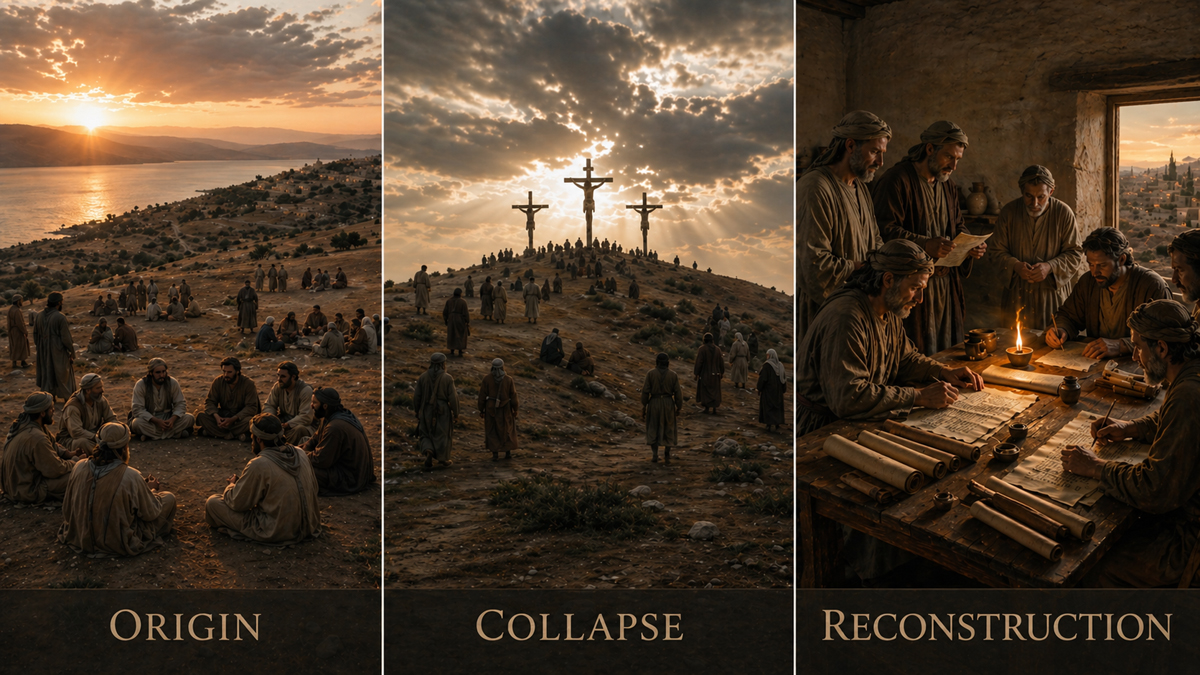
The Thesis
The Gospels appear unified, but they are best read as layered compositions rather than continuous biographies. Different streams of authority—prophetic, revolutionary, and institutional—remain present within the same narrative. Their tensions are not errors, but traces of formation. Reading attentively allows these layers to emerge, revealing a structured text shaped by multiple forces held together.
-
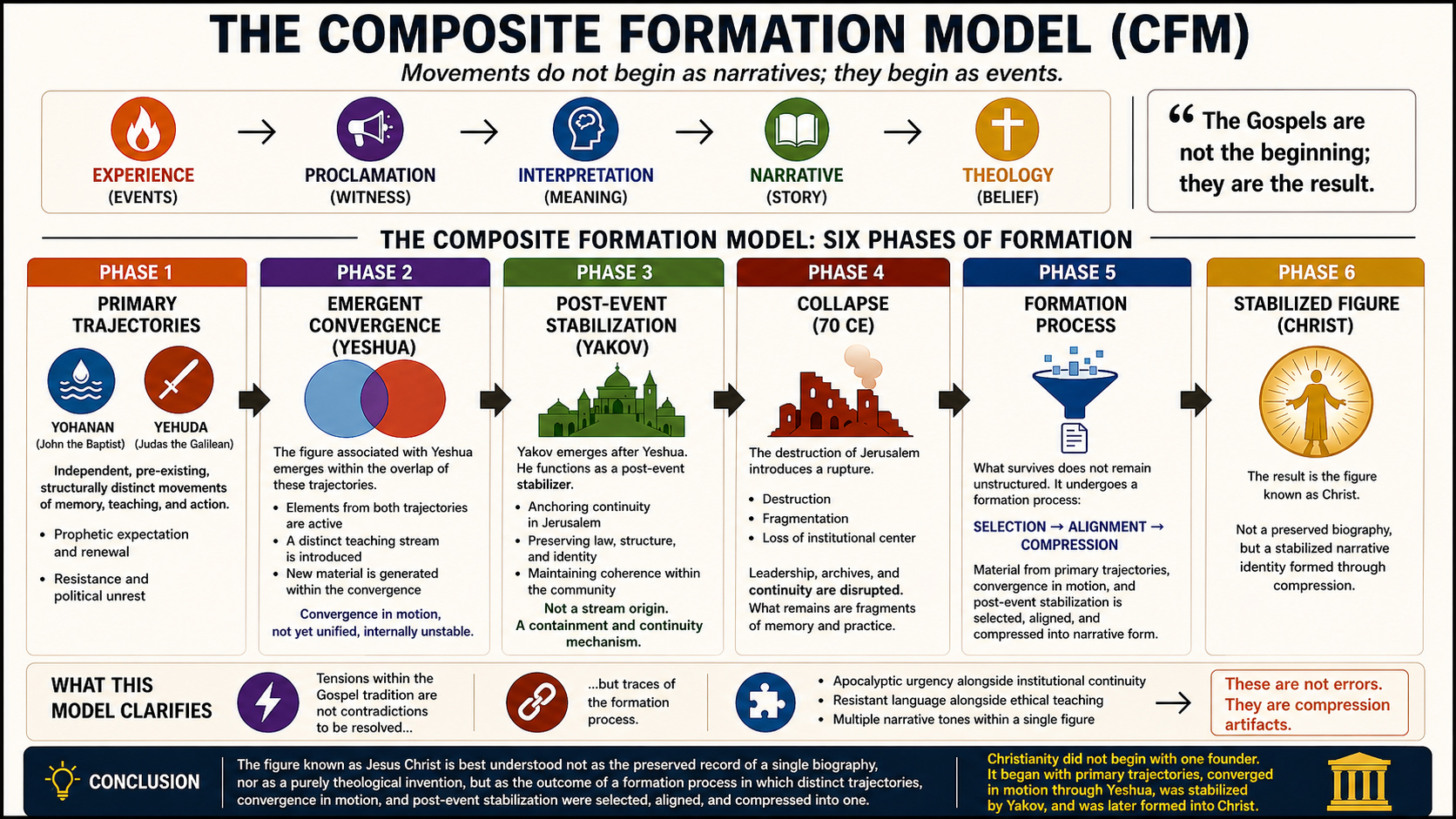
Composite Formation Model
The Composite Formation Model proposes that the figure at the center of the Gospels did not originate as a single, unified individual, but emerged through a structured process. Independent trajectories converged, were later stabilized, then fragmented and reformed through selection, alignment, and compression, producing a coherent narrative identity that reflects the outcome of development, not the starting point.
-

Understanding The Model
For nearly two thousand years, the Gospels have presented a clear, unified story of Christian beginnings. Yet the historical setting reveals a world already in motion, shaped by overlapping movements and figures responding to the same pressures. This project looks beneath the finished narrative, asking how that complexity was shaped into the single, coherent story we now recognize.
Yeshua before christ
The Making of the Christian Messiah
This work asks not whether faith matters, but how history becomes sacred, how memory becomes narrative, and how men become gods.
YbC is not an attempt to destroy faith, but to recover the human struggle, political fracture, prophetic memory, and historical trauma from which the figure of Christ emerged.

© Yeshua Before Christ