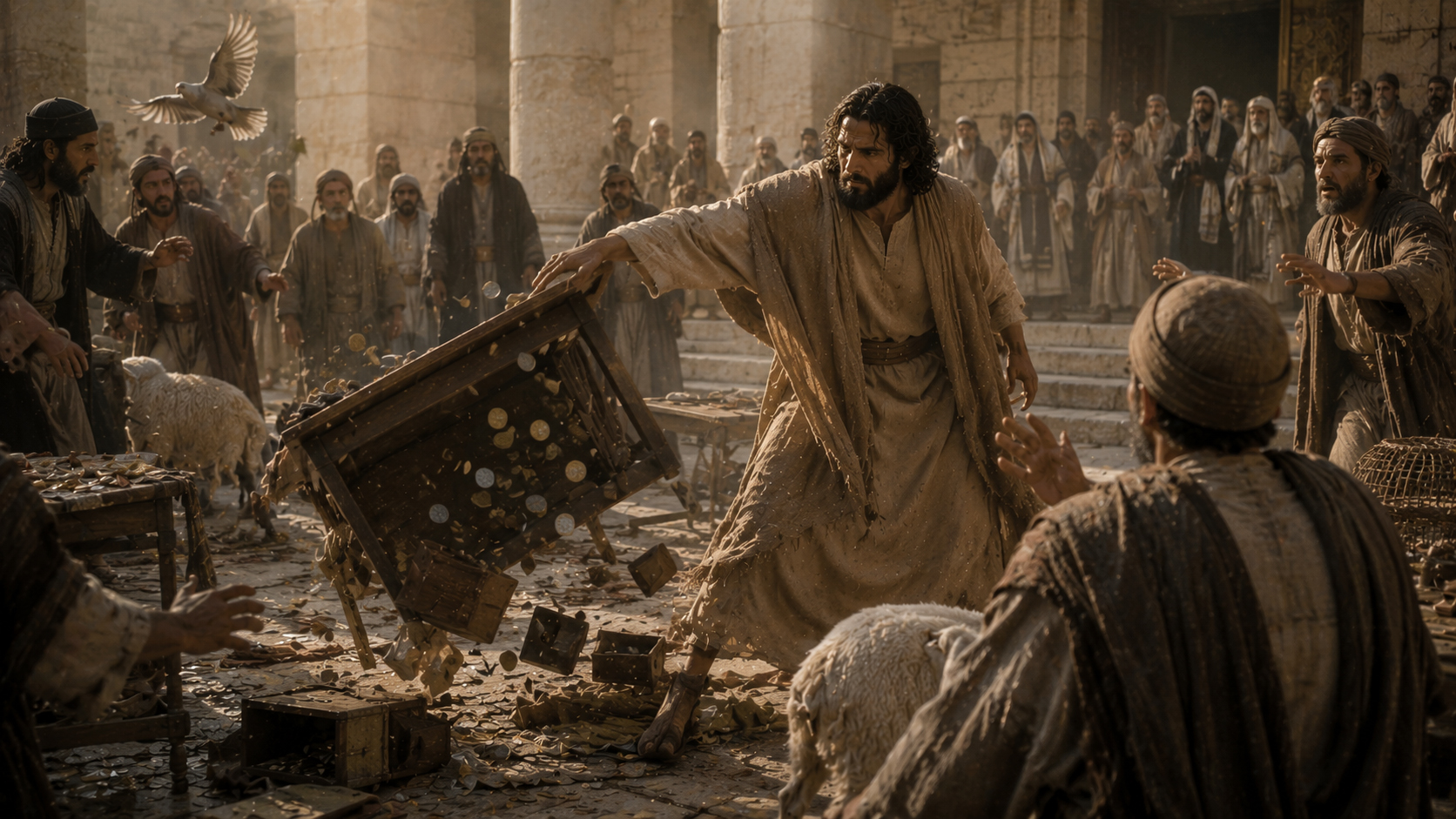
Among all the events associated with Yeshua’s final mission, none has generated more debate than the Temple demonstration. The episode occupies a central place within all four canonical Gospels and appears to belong to one of the most secure historical strata of the tradition. Yet despite its prominence, its meaning remains contested. Was it an attack upon the Temple system? A protest against economic exploitation? A symbolic purification? A revolutionary gesture? Or something else entirely?
The framework developed throughout this study suggests that these interpretations, while containing elements of truth, may not fully capture the logic of the event itself. When viewed against the wider backdrop of prophetic movements in first-century Judea, the Temple action appears less as an isolated incident and more as part of a recognizable pattern of symbolic intervention operating within the logic of performative eschatology.
The first point that deserves emphasis is the scale of the event. The Temple complex was one of the largest and most heavily frequented sacred spaces in the ancient world. The notion that Yeshua and a small group of followers temporarily shut down the entire Temple operation is historically difficult to sustain. Roman forces stationed nearby would have responded immediately to any serious attempt at seizure or occupation. The action therefore appears symbolic rather than operational. The Temple action was symbolic in form but may have been undertaken with the expectation that God would bring about real transformation through or following the action. Its purpose was not to take control of the Temple through military means or sustained occupation. Yet symbolic need not imply merely communicative. Within the prophetic worldview explored throughout this study, symbolic actions could be understood as meaningful participation in the divine transformation they anticipated. Like the prophetic demonstrations associated with Yohanan, Theudas, and the Egyptian, the Temple action may have been intended not simply to express judgment upon the existing order, but to participate in, anticipate, and help actualize the divine intervention expected to transform that order.
Yet symbolic does not mean insignificant.
Within the prophetic tradition of Israel, symbolic actions frequently functioned as enacted judgments. Prophets did not merely announce divine verdicts through speech. They embodied those verdicts through dramatic public actions. Isaiah walked barefoot as a sign. Jeremiah shattered a vessel. Ezekiel performed elaborate symbolic demonstrations concerning Jerusalem’s fate. The action itself became a prophetic proclamation.
Seen within this context, the Temple demonstration fits comfortably within an established prophetic pattern.
The traditions consistently portray Yeshua disrupting commercial activity, overturning tables, and invoking scriptural language associated with judgment. Whether every detail reflects precise historical memory is less important than the overall symbolic structure preserved by the sources. The Temple is not being attacked as a building. It is being confronted as the symbolic center of an order perceived as compromised and standing under divine scrutiny.
This interpretation becomes more persuasive when considered alongside the themes already visible throughout Yeshua’s final mission. The entry into Jerusalem invoked prophetic expectation through symbolic reenactment. The Temple action continues the same logic. The movement is no longer merely approaching the symbolic heart of Israel. It is now acting within it.
The significance of the location cannot be overstated. Throughout this study, sacred geography has emerged as one of the defining features of prophetic activism. The Jordan, the wilderness, the Mount of Olives, and Jerusalem itself functioned as locations where sacred history and present action intersected. The Temple represented the most symbolically charged space of all. It stood at the center of covenantal identity, sacrificial worship, priestly authority, and national memory. To perform a prophetic demonstration there was to direct judgment toward the symbolic core of the existing order.
This helps explain why the event likely generated such concern among authorities. The danger did not lie in immediate military capability. As with Yohanan, Theudas, and the Egyptian, the deeper issue involved symbolic authority exercised before gathered crowds within an atmosphere already saturated with expectation. Public actions undertaken in the Temple possessed the potential to resonate far beyond the action itself because they touched questions of legitimacy, authority, covenant, and divine favor.
The event also illuminates the convergence of the two trajectories traced throughout this study. The ethical concerns visible in the earliest Jesus tradition do not disappear. Critiques of wealth, hierarchy, exclusion, and corruption remain present. Yet those concerns are now expressed through a form of prophetic action shaped by apocalyptic expectation and symbolic confrontation. Ethical adaptation has merged with prophetic activism.
This convergence may be the key to understanding why the Temple demonstration differs both from revolutionary violence and from purely symbolic teaching. A revolutionary seeks to seize power. A teacher seeks to persuade. A prophet seeks to reveal divine judgment through symbolic action. The Temple event appears to belong most naturally within the third category.
The concept of performative eschatology helps clarify this distinction. If symbolic actions were understood as participation within sacred history, then the Temple demonstration was not merely a critique of the present order. It was an attempt to embody, anticipate, and help actualize the divine judgment expected to transform that order. Whether Yeshua anticipated specific consequences flowing from the action cannot be determined with certainty, but the act itself appears consistent with a prophetic worldview in which symbolic intervention and historical expectation were not mutually exclusive categories.
This perspective also explains why the demonstration need not have possessed a realistic prospect of immediate success. The effectiveness of the act did not depend upon controlling the Temple, removing the priesthood, or defeating Roman authority. Its significance derived from its symbolic participation in the sacred process it proclaimed. The prophet’s task was not to accomplish divine transformation independently but to enact faithfully the reality anticipated through divine intervention.
Viewed in this way, the Temple demonstration becomes the clearest expression of performative eschatology within the entire public ministry of Yeshua. The themes developed throughout this study converge here with remarkable clarity: sacred geography, prophetic reenactment, symbolic action, covenantal judgment, public performance, and expectation of divine intervention all meet within a single event.
Yet such actions carried unavoidable consequences.
The same logic that made the Temple demonstration meaningful also made it dangerous. A prophetic act performed publicly at the symbolic center of Jewish life could not easily remain invisible to authorities responsible for maintaining order. Whether interpreted as religious provocation, political threat, or both, the action placed Yeshua on a collision course with the structures governing Jerusalem.
The Temple demonstration therefore marks the moment at which symbolic confrontation becomes historical crisis.
What follows is no longer merely the performance of judgment. It is the response of imperial and priestly power to that performance. The road from prophetic action to crucifixion now becomes increasingly difficult to avoid.
→ Continue through Performative Eschatology: From Prophetic Action to Crucifixion