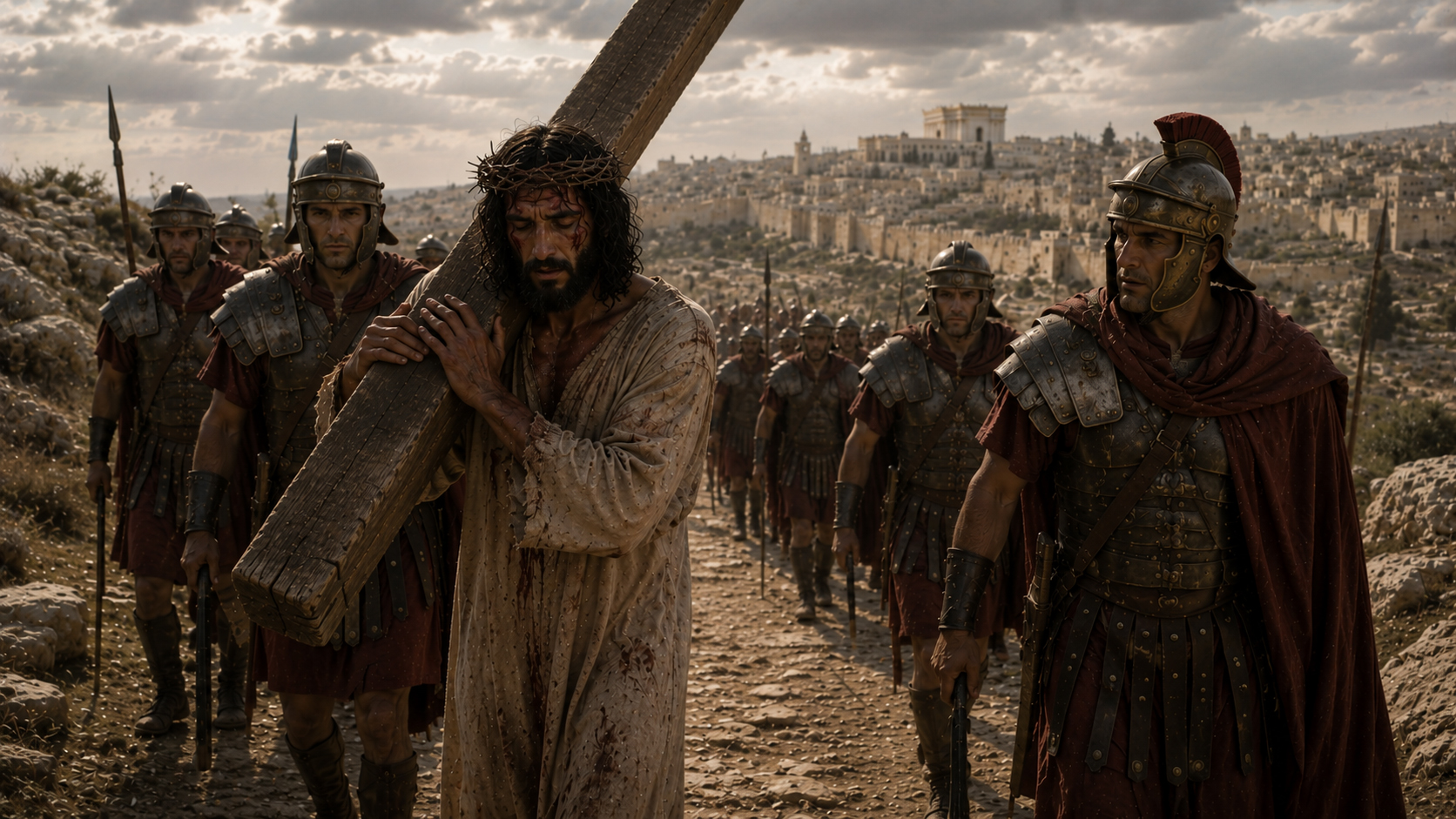
The final days of Yeshua’s public activity have often been interpreted through sharply contrasting frameworks. Some reconstructions emphasize political rebellion and treat the crucifixion primarily as Rome’s response to revolutionary activity. Others stress theological or spiritual themes and present the execution largely as the consequence of religious misunderstanding, personal hostility, or theological conflict. Yet the historical trajectory reconstructed throughout this study suggests a different possibility. The events leading to the crucifixion become most intelligible when viewed as the culmination of a broader pattern already visible in the movement of Yohanan and later reflected in the activities of prophetic figures such as Theudas and the Egyptian who emerged within the crisis atmosphere of first-century Judea.
From the beginning, these movements operated at the unstable intersection of sacred expectation and political order. Their leaders attracted followers not primarily through military organization but through symbolic authority, prophetic performance, and the conviction that divine intervention was approaching. The danger they posed did not depend solely upon what they intended. It also depended upon how their actions were perceived within a society already burdened by occupation, covenantal anxiety, and apocalyptic expectation.
The final mission of Yeshua displays many of the characteristics associated with this broader prophetic pattern. Yeshua’s final actions were symbolic, prophetic, and performative, but they were not necessarily intended as mere demonstrations. Like other apocalyptic prophets of the period, he may have expected those actions to contribute to, precipitate, or help actualize the divine transformation he believed was imminent Like Yohanan, he operated outside traditional structures of authority. Like Theudas and the Egyptian, he engaged sacred geography through public symbolic action. Like numerous prophetic figures preserved by Josephus, he acted before gathered crowds within locations saturated with scriptural and national significance. The entry into Jerusalem and the Temple demonstration represent the clearest expressions of this pattern, bringing performative eschatology directly into the symbolic heart of Jewish life.
The significance of these actions becomes especially apparent when viewed from the perspective of those responsible for maintaining order. Roman administration depended upon predictability, deterrence, and control of public space. The Temple authorities likewise occupied a delicate position, balancing religious legitimacy, popular expectation, and political stability. A charismatic figure attracting public attention while performing prophetic demonstrations in Jerusalem threatened to disrupt that balance regardless of whether organized rebellion was intended.
This observation helps explain why the question of intention may ultimately be less important than the question of perception. Yeshua may not have envisioned military confrontation with Rome in the manner associated with later revolutionary movements. Yet symbolic actions undertaken within Jerusalem during a period of heightened expectation could easily be interpreted as destabilizing. The issue was not simply what Yeshua believed he was doing. The issue was how prophetic performance intersected with the concerns of authorities responsible for preserving order in an already volatile environment.
The logic reconstructed throughout this study suggests that such confrontation was increasingly difficult to avoid. Performative eschatology encouraged symbolic action precisely because symbolic action was understood as participation within sacred history. Sacred geography directed attention toward Jerusalem because Jerusalem occupied the center of covenantal memory and prophetic expectation. Apocalyptic expectation altered the way people evaluated risk because divine intervention was believed capable of changing the course of history entirely. Taken together, these elements created a trajectory that naturally moved toward public confrontation.
This does not mean that the crucifixion was inevitable in a deterministic sense. History always contains contingency. Yet once Yeshua entered Jerusalem and began acting publicly within the symbolic framework examined throughout this study, the possibility of suppression increased dramatically. The same dynamic visible in the execution of Yohanan now reappeared on a larger stage. Once prophetic authority, sacred symbolism, and public expectation converged within Jerusalem itself, intervention by political authorities became increasingly probable.
The method of execution reinforces this conclusion. Crucifixion was not a punishment ordinarily associated with theological disagreement alone. It functioned as a public instrument of imperial control designed to deter perceived threats to order. Whatever theological disputes may have surrounded Yeshua’s activity, the decision to execute him reflects the fact that his movement had entered the sphere of political concern. As with Yohanan before him, the danger appears to have resided less in organized military capability than in the unpredictable consequences of charismatic authority operating within an apocalyptic environment.
Yet the crucifixion also reveals the limits of a purely political interpretation. If Yeshua is reduced to a failed revolutionary, much of his activity becomes difficult to explain. Throughout this study, his actions have appeared less concerned with military strategy or organized resistance than with symbolic performance, scriptural reenactment, and expectation of divine intervention. They belong to the world of prophets rather than insurgents.
This does not mean that Yeshua’s movement lacked political implications. On the contrary, symbolic actions grounded in sacred history could become deeply unsettling within a society already charged with apocalyptic expectation. The crucifixion therefore appears not as the suppression of a revolutionary movement in the later Zealot sense, but as the suppression of a prophetic movement whose symbolic actions, public demonstrations, and claims about God’s coming kingdom had become politically dangerous.
The broader significance of this conclusion extends beyond the historical reconstruction of a single event. It suggests that the categories often used to interpret Yeshua; spiritual teacher, social reformer, revolutionary nationalist, apocalyptic prophet, may each capture part of the picture while failing to account for the whole. The framework of performative eschatology provides a way of integrating these elements without collapsing them into a single reductive category.
The earliest layers of the tradition preserve concerns with ethical transformation, communal reconstruction, and alternative social relations. The later Jerusalem traditions reveal increasing engagement with sacred geography, prophetic symbolism, and public performance. Rather than representing unrelated phases, these developments may reflect the convergence of two responses to the same underlying crisis: Galilean ethical adaptation and Judean apocalyptic intensification. The final mission of Yeshua emerges at the point where these currents meet.
Viewed from this perspective, the road from Galilee to Jerusalem appears less as a sudden change of direction than as a process of development. Ethical reconstruction gradually converges with prophetic activism. Communal transformation converges with sacred reenactment. The kingdom of God moves from an alternative mode of life toward a public symbolic confrontation with the existing order. Jerusalem becomes the stage upon which that convergence reaches its fullest expression.
The crucifixion therefore stands not simply as the end of Yeshua’s mission but as the culmination of a trajectory visible throughout the wider historical environment from which the movement emerged. The same crisis conditions that produced competing responses within Jewish society also produced prophetic movements centered upon symbolic action and divine expectation. Yohanan represented one early expression of this pattern. Yeshua brought it to its most sophisticated and consequential form.
Conclusion
The argument developed throughout this study has sought to situate Yeshua within the wider world of first-century Galilee and Judea rather than isolating him from it. That world was shaped by Roman domination, covenantal anxiety, social instability, competing religious responses, and growing apocalyptic expectation. Within that environment emerged a series of prophetic movements that operated through symbolic action, sacred geography, charismatic authority, and expectation of divine intervention.
Yohanan the Baptist provides one of the earliest and clearest examples of this phenomenon. The movements of Theudas and the Egyptian demonstrate that he was not unique. Together they reveal a recurring pattern of prophetic activism that cannot be adequately explained through the categories of either peaceful spirituality or organized revolutionary nationalism alone.
The concept of performative eschatology offers a framework for understanding this pattern:
Symbolic actions were not merely representations of future hope. They were often understood as meaningful participation within the sacred realities they anticipated. Sacred geography supplied the stage upon which such participation occurred, while apocalyptic expectation transformed the meaning of risk, suffering, and confrontation.
Viewed through this lens, Yeshua’s final mission acquires a new coherence. The entry into Jerusalem, the Temple demonstration, and the events leading to crucifixion appear not as isolated episodes but as components of a broader prophetic strategy rooted in symbolic reenactment and sacred expectation. The movement that began within the villages of Galilee ultimately converged with the apocalyptic-prophetic currents already active within Judea, producing a form of public religious activism that was simultaneously compelling to followers and threatening to those responsible for maintaining order.
Yeshua was neither simply a revolutionary nor simply a spiritual teacher. He emerged from a prophetic world in which symbolic action, sacred geography, covenantal expectation, and divine intervention remained deeply intertwined. Understanding that world allows us to see the final mission not as an anomaly but as the culmination of a broader apocalyptic-prophetic tradition already visible throughout first-century Judea.
The significance of this conclusion extends beyond the reconstruction of a single historical figure. It challenges modern categories that too often separate religion from politics, symbolism from action, and theology from history. For many Jews living under Roman domination, these distinctions were neither obvious nor easily maintained. Sacred memory, prophetic expectation, and public action existed within a single interpretive world in which divine purposes were believed to unfold through historical events. Viewed within that context, Yeshua’s final mission appears not as an inexplicable departure from his environment, but as one of its most fully developed expressions. The road from Galilee to Jerusalem was therefore more than a geographical journey. It was the culmination of a worldview in which symbolic action could become participation in sacred history and in which the hope of divine intervention could transform ordinary history into a stage for prophetic expectation.